
Imagine an AI system that does more than answer questions. It can access databases, read company documents, examine source code, and interact with the applications you use every day.
All without requiring a separate custom integration for every AI application.
This is the idea behind the Model Context Protocol (MCP), an open standard designed to connect AI applications with external data sources and tools through a standardized interface.
MCP represents an important development in the artificial intelligence ecosystem, expanding the possibilities of AI beyond traditional text generation.
Recommended posts



What Is Model Context Protocol (MCP)?
Model Context Protocol, commonly known as MCP, is an open-source protocol introduced by Anthropic in November 2024. It provides a standardized communication interface between AI applications and external data sources, services, and tools.
MCP is often described as the USB-C of AI applications. Just as USB-C provides a common connection standard for different devices, MCP offers a standardized approach for connecting AI applications to different systems without rebuilding integrations for every combination of applications.
Through MCP, AI applications can interact with various systems, including:
- Databases and data storage systems.
- Code repositories such as GitHub.
- Company documents and files.
- External APIs and services.
- Project management systems.
- Software development tools.
- Internal enterprise applications and infrastructure.
Access depends on the configuration, permissions, and capabilities provided by each integration.
Why Do We Need MCP?
One of the major challenges in developing AI-powered applications is integration complexity.
Without a standardized approach like MCP, developers often need to build custom connections for each application or data source they want to integrate with AI.
For example, a company may want to develop an AI assistant capable of accessing customer databases, reading internal documentation, examining code repositories, and retrieving information from project management systems.
Each system may have different APIs, authentication methods, and data formats. This increases development and maintenance complexity.
MCP addresses this challenge by providing a standardized communication interface that can be reused across compatible AI applications.
Developers still need to provide integrations with external systems, but those integrations do not necessarily need to be rebuilt for every AI application.
How Does MCP Work?
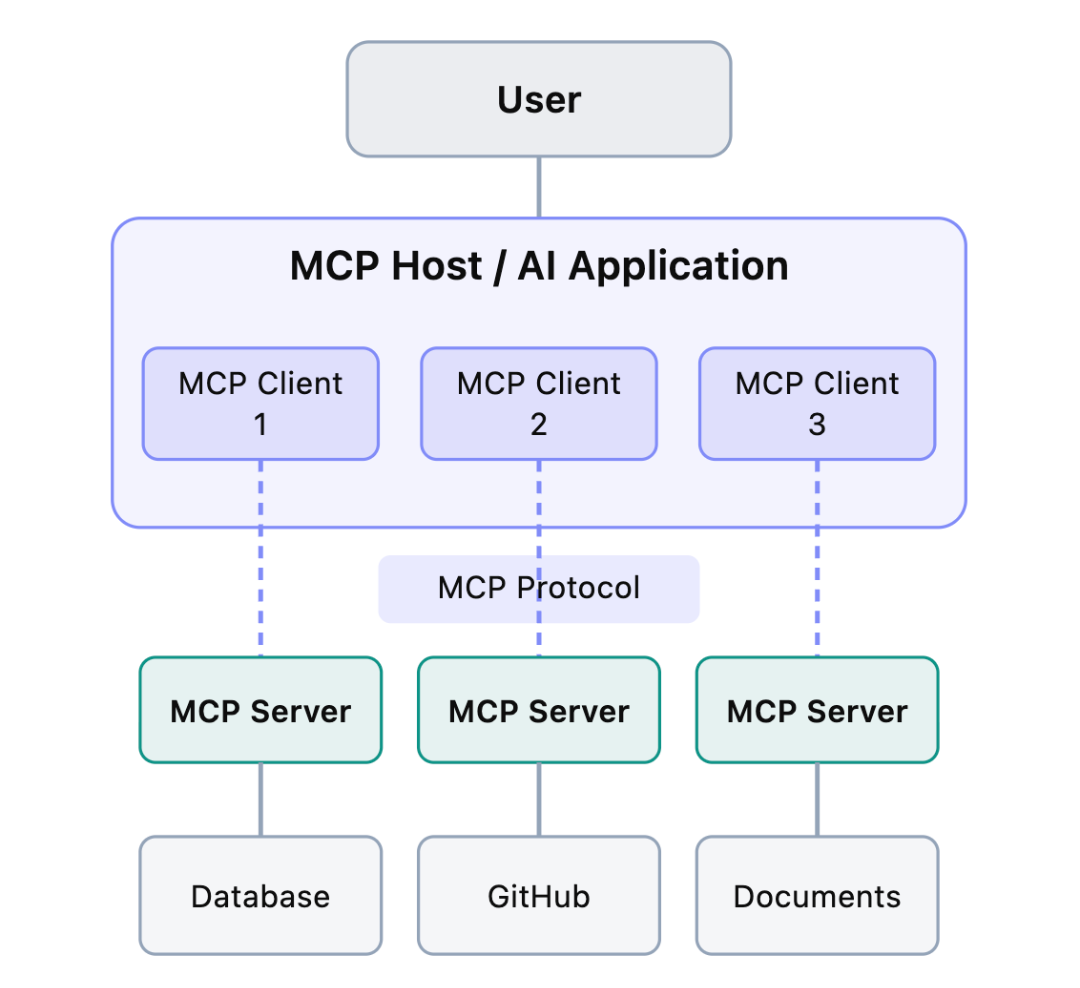
MCP follows a client-server architecture consisting of three main components.
1. MCP Host
The MCP Host is the AI application responsible for managing user interactions and connections to MCP Servers.
Examples include AI assistants, Integrated Development Environments (IDEs), and other AI-powered platforms that support MCP.
2. MCP Client
The MCP Client is a component within the host that establishes and manages connections with an MCP Server.
It handles message exchanges, capability negotiation, and requests made through the MCP protocol.
3. MCP Server
An MCP Server is a service that exposes specific capabilities to AI applications.
For example, an MCP Server may provide functionality for reading databases, searching documents, examining repositories, or performing specific operations through an API.
From a technical perspective, MCP uses JSON-RPC 2.0 as its messaging format. Communication can take place locally through standard input/output (stdio) or remotely through Streamable HTTP.
This architecture allows AI applications to discover available capabilities and use them according to their requirements and granted permissions.
Three Core MCP Server Capabilities
MCP Servers can expose three primary types of capabilities.
Resources
Resources provide data or contextual information that AI applications can use, such as documents, configuration files, and database information.
Tools
Tools are callable functions that perform specific operations, such as searching for information, retrieving data through APIs, or generating reports.
Prompts
Prompts provide reusable instruction templates or interaction workflows designed for specific tasks.
Together, these capabilities allow AI applications to obtain context and interact with external systems in a more structured way.
MCP vs. API: Does MCP Replace APIs?
MCP and APIs serve complementary purposes.
APIs enable applications to communicate and exchange data through predefined interfaces.
MCP, on the other hand, provides a standard that helps AI applications discover and use capabilities exposed by external systems.
An MCP Server can use REST APIs, GraphQL, or other mechanisms to communicate with underlying services.
In other words, MCP does not replace APIs. It provides an integration layer that helps AI applications interact with existing services and data.
Practical MCP Use Cases in IT
Software Development
Developers can connect AI applications to code repositories to better understand project structures, search documentation, review code changes, and identify potential bugs.
IT Infrastructure and Monitoring
MCP can connect AI applications with monitoring systems, helping IT teams inspect server status, read logs, and analyze system performance information.
Data Analytics
With appropriate connections and permissions, AI applications can retrieve information from databases to support data analysis, reporting, and pattern identification.
Enterprise Knowledge Management
Organizations can connect AI assistants to internal documentation, knowledge bases, and information systems to generate responses that are more relevant to their business needs.
Workflow Automation
MCP can also support workflow automation by connecting AI applications with tools used in everyday business operations.
Is MCP Secure?
The ability of AI applications to access data and execute external functions introduces new security challenges.
Organizations should consider several security practices before implementing MCP:
- Implement appropriate authentication and authorization.
- Follow the principle of least privilege.
- Use MCP Servers from trusted sources.
- Protect API keys and credentials.
- Address prompt injection risks.
- Implement activity logging and auditing.
- Require user approval for sensitive operations.
MCP provides a communication standard, but it does not automatically guarantee the security of every integration. Security ultimately depends on how hosts, servers, and external systems are developed and configured.
MCP and the Future of the AI Ecosystem
The evolution of AI is no longer focused solely on generating responses. It is increasingly about how AI can interact with existing digital systems.
MCP creates opportunities to build a more interoperable, modular, and connected AI ecosystem.
For developers, it can reduce repetitive integration work. For organizations, it opens opportunities to incorporate AI into operational processes while maintaining appropriate security and data governance.
Looking ahead, the ability of AI to understand context, access information, and use tools effectively could become an important factor in the development of intelligent applications.
AI is evolving beyond a technology that simply provides answers. It is becoming an interface that connects people with digital systems.
And MCP is one of the standards helping make that transformation possible.